The following are some illustrations done by Chinese artist Liu Young, who had lived in Germany, showing some differences between high-context cultures vs. low-context cultures transnationally.
The blue and red, respectively, portray the West in comparison to the East.
Opinion:

Way of Life:
Punctuality:

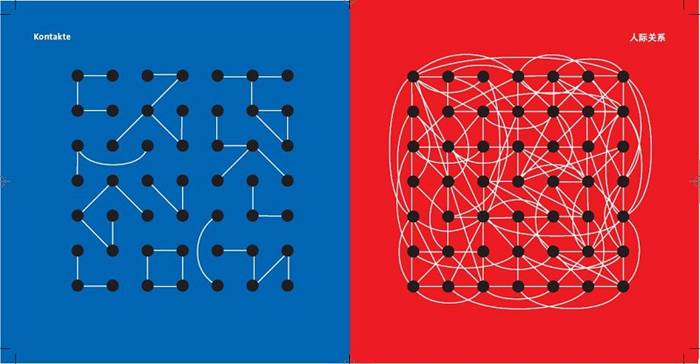
Contacts:
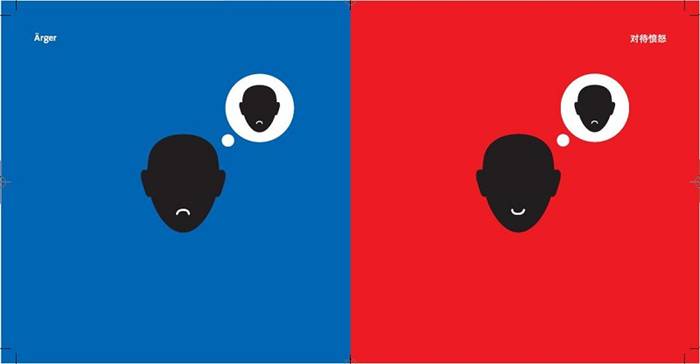
Anger:
Party:

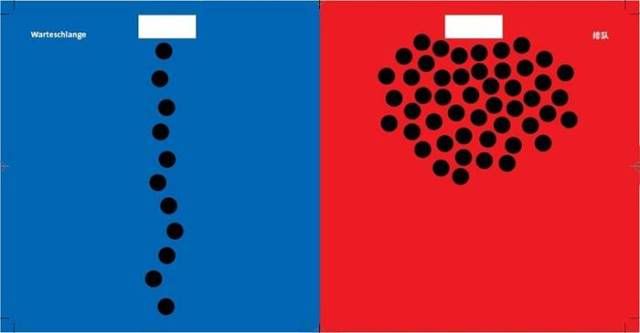
Queue:
I wonder how those who haven't necessarily encountered both context cultures would interpret these illustrations above. I wonder if they can feel the absurdity.
As a first generation immigrant, I've grown up among the two; and for me these images reflect a sort of richness due to the mélange, but also a kind of strife due to the inherent duplicity.
On the topic of communication with others that are different from you—
Born in the states, I always respond to the occasional "Where are you from?" inquiry with the unsatisfactory "Texas" (my birthplace) even though it's obvious that what people want to hear (after they ask a second time) is "Well, my parents are originally from Bangladesh". And , yes, even though I am, too, Bengali, I make the distinction that it's my parents who are from elsewhere; I make the distinction that my culture is very much American.
But this is, in a sense, untrue, for cultures are not distinct between countries and large groups of people, but distinct at the level of the individual.
My reasoning for making such a distinction has most times been to knock down that figurative wall in communication, to negate any conception that whoever is speaking to me and I are in any way culturally different, so that I can be perceived as relatable and an equal... But this is what I realize now, that each person in fact has a different culture of their own, made up of their unique experiences, incomparable to another's.
Understanding that diversity occurs at the individual level, that similarities and differences should not be assumed and that stereotypes and prejudices should not be applied, is most important for communication in itself because everyone is different from you.

No comments:
Post a Comment