Tuesday, December 10, 2013
Final Reflection
I was pleasantly surprised by this course. While I had come into the class thinking it would be trite and unimportant like most other courses that are part of the general education requirement, having completed it, I now believe that it is invaluable (although 99.9% of the reason why I ended up enjoying this course was because of the professor1).
There wasn't a class that I didn't learn something new or didn't find intriguing. So, there's no word to describe how I feel about having thought before this course that communication was only about talking. Silly? Stupid? Really stupid? I honestly do feel like a learned a lot about things I didn't expect there was anything left to learn about. I especially learned a lot about myself.
Communication is so essential to our being that I can't believe that I had ever discounted it. Everything we covered was applicable to everyday scenarios and I kind of wish we could have gone more in-depth into it.
That being said, the material couldn't have resonated with the class without having been taught the way it was, I mean, I don't think I've ever laughed so much in a class before!
1Thank you for being amazing :)

Problem Solving Sequence
I'm not sure if there's any part of the problem solving sequence that I could think of changing. I mean, the assignment wasn't too difficult, but it's arguable if that would need changing since it meets its purpose, regardless. But then again, I think it might be interesting to have the students participate in a problem solving sequence in which the groups' proposed solutions could be implemented and tested during the class period. While through the exercise the groups were able to identity the problems and their options and etc., from what I remember, each group's propositions (including my own group's) tended to be more non-solutions (i.e. not doing anything about the road). Still, I liked that the problem we were "solving" was indeed a real problem, with realistic components to consider, but fictionalized into a context the groups could find humor in.
Stress and Priorities

Stress is stifling. Before I've even recognized that I'm feeling it, I begin to shut down. I procrastinate some, then procrastinate some more, all the while feeding my mind the lie that I'm accomplishing something. (For example, if I'm stressed about a paper I have to write, I'll type the heading and then play around with a title for an hour and half before settling on what was given on the rubric in the first place: "Reflection Paper"). I divert my attention to something else so I am not preoccupying myself with whatever it is that I am stressed about; but as we all know, stress tends to permeate into everything else too.
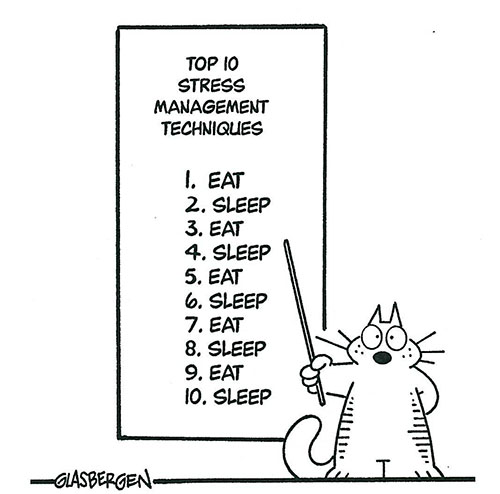
Sometimes stress is accompanied with a kind of adrenaline or high that, if stressed long enough, can get you motivated and doing some of the best work of your life (however, this of course comes with the cost of immense douleur beforehand). So, before I get to the point of crawling into bed for hours on end, I make the effort to trivialize what it is that I'm stressed about, to find another context. I typically become stressed about assignments or presentations, things that hold a lot of weight in an academic sense. I become crippled with the thought of "what if I can't do this", even if it's not entirely difficult, even if I wholly know it's possible to do. This stress stems from the notion that this one grade will affect me for years to come, that it'll somehow be responsible for this or that or whatever. This is when other people (i.e. friends) become helpful.
When I become stressed and overwhelmed, I instinctively isolate myself, thinking I can alleviate the stress by removing all distractions and just getting to work on whatever it is that I need to get done. Unfortunately, you yourself are your biggest distraction, so nothing gets done in this scenario, and the stress multiplies. Meeting up with friends or simply conversing with others, however, (although also distracting) is better for managing stress because others distract the stress away from you. Often times everyone else has their own worries too, and your stresses can't be compared, and you realize what you're stressing about often times isn't a big deal.
Until then, I'll do things like make a list and stare at it, but chocolate helps too.
Tuesday, November 26, 2013
Group Reflections
Before this, our group's communication was stilted and impersonal. While all of us had exchanged our numbers, I, myself, hadn't taken the time to save any of their information into my "contacts" and literally did not know for a while who I was communicating with as anyone other than "a person from my group". In other situations in which I had worked with peers I hadn't been acquainted with beforehand and had to communicate virtually with, we had at the very least communicated via Facebook, which somehow feels a little less impersonal when you see a group member's picture pop up whenever they write something, instead of a grey blob of text. So, I am glad we had the foresight to meet, as that improved our communication drastically.
Beforehand, the communication was led by one person and very few would offer their own ideas, going along with what was presented, whereas afterwards the communication was much more equally spread and effective.
Tuesday, November 12, 2013
Public Speaking
Chances are that everyone will take part in some sort or form of public speaking at least once in their lifetime, whether they fancy public speaking or not.

I'm no longer as terrified as I had been of public speaking. With frequency and practice getting up in front of an audience isn't as difficult anymore—but that is not to say that the actual act of public speaking is any easier.
There are many aspects of public speaking to consider in order to be a good public speaker, such as aspects of physical and vocal delivery which are all too easy to go awry.
For me, volume has always been the culprit of my public speaking disasters. I'm naturally a soft-spoken speaker (which I didn't realize until a pattern arose of the audience being unable to hear what I've said during nearly every presentation I'd given). It's hard to gauge if I've been successful in rectifying this. It's one of those little things you have to keep in mind (along with the other million little things). To improve this I will have to, in a way, be aware of it without worrying about it. I'll need to rehearse and be confident in what it is that I have to say.
A speech that resonates with me is Martin Luther King Jr.'s "I Have a Dream", not because it is classic, but because of its prowess and unwavering strength and hope that have rendered it classic, as well as having rendering a movement and change in civil society.
There are many aspects of public speaking to consider in order to be a good public speaker, such as aspects of physical and vocal delivery which are all too easy to go awry.
For me, volume has always been the culprit of my public speaking disasters. I'm naturally a soft-spoken speaker (which I didn't realize until a pattern arose of the audience being unable to hear what I've said during nearly every presentation I'd given). It's hard to gauge if I've been successful in rectifying this. It's one of those little things you have to keep in mind (along with the other million little things). To improve this I will have to, in a way, be aware of it without worrying about it. I'll need to rehearse and be confident in what it is that I have to say.
A speech that resonates with me is Martin Luther King Jr.'s "I Have a Dream", not because it is classic, but because of its prowess and unwavering strength and hope that have rendered it classic, as well as having rendering a movement and change in civil society.
Friday, October 25, 2013
Relationship Development
My first reaction to Mark Knapp and Anita Vangelisti's model of developmental stages within relationships is that it seems too contrived; but, then again, I'm not a communications scholar. The model is applicable, perhaps, but I can only use it to describe relationships en masse. No one relationship in particular sticks out that seems unique to explain through use of the model.
I have not had a relationship reach the intimacy stage, romantically, and question (now, looking at the model) if my relationships at the intensification stage are, as Knapp and Vangelisti have put it, "stable" or "stagnant".
In my experience, most of my relationships have carried out in one or the other of the following manners:
1. The relationship begins at the pre-interaction awareness stage, and that is where it stays.
2. There was no pre-interaction awareness stage, thus the relationship begins at the initiation stage, and that is where it stays.
3. Or, the relationship begins at either one of the previous stages and proceeds to the exploration stage, which is where it stays until it is time for it to move into the intensification stage.
And there we have it.
Of course some relationships are more intricate, but the model does not leave room to disclose factors such as the duration of a relationship, or the time spent between stages and at each stage.
I have not had a relationship reach the intimacy stage, romantically, and question (now, looking at the model) if my relationships at the intensification stage are, as Knapp and Vangelisti have put it, "stable" or "stagnant".
In my experience, most of my relationships have carried out in one or the other of the following manners:
1. The relationship begins at the pre-interaction awareness stage, and that is where it stays.
2. There was no pre-interaction awareness stage, thus the relationship begins at the initiation stage, and that is where it stays.
3. Or, the relationship begins at either one of the previous stages and proceeds to the exploration stage, which is where it stays until it is time for it to move into the intensification stage.
And there we have it.
Of course some relationships are more intricate, but the model does not leave room to disclose factors such as the duration of a relationship, or the time spent between stages and at each stage.
However, one part of the metaphor, relating relationship development to an elevator stopping at every floor of a high-rise of relational stages, that interests me is the mention of riding the elevator together in order to make a relationship work.
It is time to reflect on whether I am in the elevator alone with any of my relationships.

It is time to reflect on whether I am in the elevator alone with any of my relationships.

Wednesday, October 16, 2013
Diversity
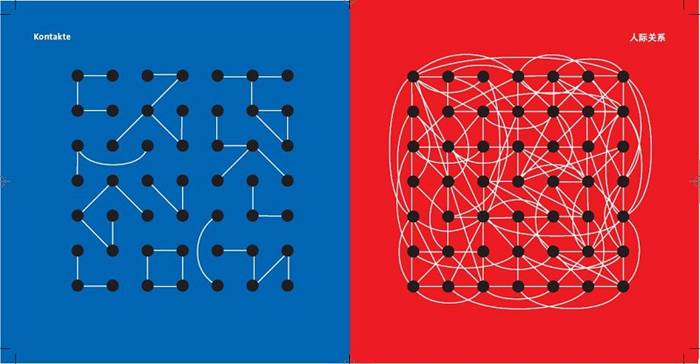
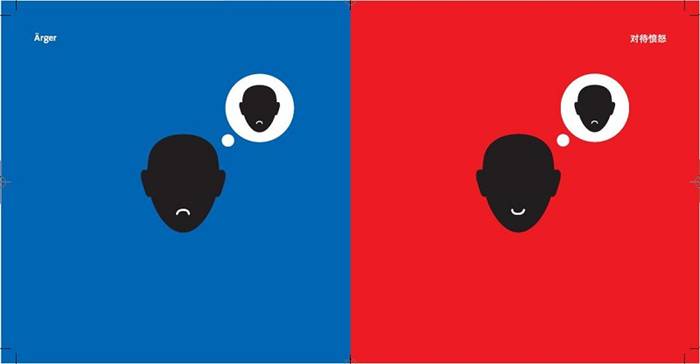
The following are some illustrations done by Chinese artist Liu Young, who had lived in Germany, showing some differences between high-context cultures vs. low-context cultures transnationally.
The blue and red, respectively, portray the West in comparison to the East.
Opinion:

Way of Life:
Punctuality:

Contacts:
Anger:
Party:

Queue:
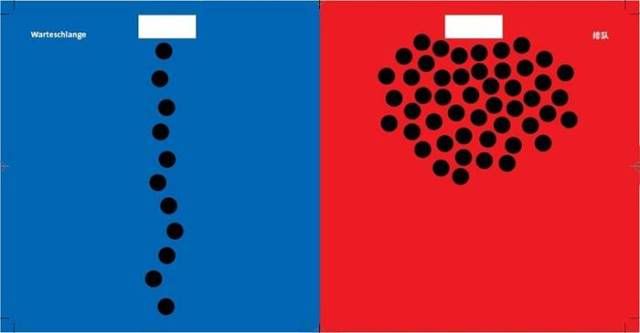
I wonder how those who haven't necessarily encountered both context cultures would interpret these illustrations above. I wonder if they can feel the absurdity.
As a first generation immigrant, I've grown up among the two; and for me these images reflect a sort of richness due to the mélange, but also a kind of strife due to the inherent duplicity.
On the topic of communication with others that are different from you—
Born in the states, I always respond to the occasional "Where are you from?" inquiry with the unsatisfactory "Texas" (my birthplace) even though it's obvious that what people want to hear (after they ask a second time) is "Well, my parents are originally from Bangladesh". And , yes, even though I am, too, Bengali, I make the distinction that it's my parents who are from elsewhere; I make the distinction that my culture is very much American.
But this is, in a sense, untrue, for cultures are not distinct between countries and large groups of people, but distinct at the level of the individual.
My reasoning for making such a distinction has most times been to knock down that figurative wall in communication, to negate any conception that whoever is speaking to me and I are in any way culturally different, so that I can be perceived as relatable and an equal... But this is what I realize now, that each person in fact has a different culture of their own, made up of their unique experiences, incomparable to another's.
Understanding that diversity occurs at the individual level, that similarities and differences should not be assumed and that stereotypes and prejudices should not be applied, is most important for communication in itself because everyone is different from you.
Subscribe to:
Comments (Atom)